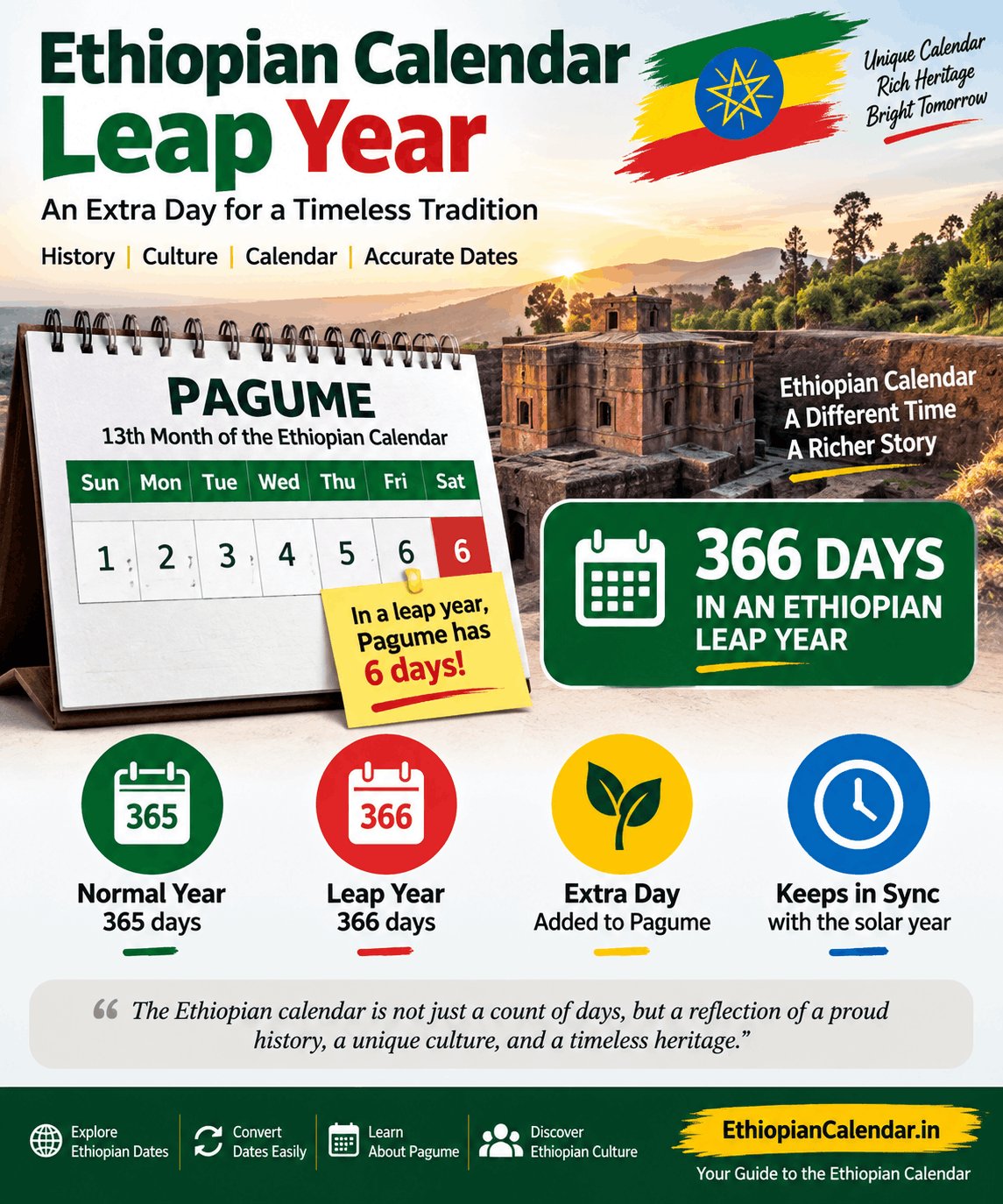
The Ethiopian calendar leap year is a year in which the 13th month, Pagume, has 6 days instead of the usual 5 days. This extra day makes the Ethiopian calendar year 366 days long. Understanding Ethiopian leap years is useful when checking Ethiopian dates, converting dates to the Gregorian calendar, and determining the length of Pagume.
What Is an Ethiopian Leap Year?
An Ethiopian leap year occurs every four years and has an extra day in Pagume, the 13th month. A normal Ethiopian year has 365 days, while a leap year has 366 days. The extra sixth day is added to Pagume at the end of the Ethiopian calendar year. This helps keep the Ethiopian calendar aligned with the solar year.
How Often Does the Ethiopian Calendar Have a Leap Year?
The Ethiopian calendar generally follows a four-year leap-year cycle. In a leap year, Pagume has 6 days instead of 5. This additional day brings the total number of days in the Ethiopian year to 366. The leap-year cycle is an important part of the Ethiopian calendar system and affects the length of Pagume and the relationship between Ethiopian and Gregorian dates.
Pagume in an Ethiopian Leap Year
In an Ethiopian leap year, Pagume has 6 days instead of 5 days. The sixth day is the additional day that makes the Ethiopian calendar year 366 days long. Pagume remains the 13th and final month, coming immediately before Meskerem 1, the Ethiopian New Year.
How Does an Ethiopian Leap Year Affect Dates?
An Ethiopian leap year changes the length of the calendar year by adding one extra day to Pagume. This can affect the corresponding Gregorian date when converting dates around the end of the Ethiopian year. For accurate conversion between the two calendar systems, use our Ethiopian Date Converter to check the corresponding date.
Ethiopian Leap Year vs Gregorian Leap Year
Both the Ethiopian and Gregorian calendars use leap years to keep their calendar systems aligned with the solar year, but the extra day is placed differently. In the Ethiopian calendar, the additional day is added to Pagume, making it 6 days long. In the Gregorian calendar, the extra day is added to February, which has 29 days in a leap year. The two systems therefore use different methods for handling the additional day.
Why Is the Ethiopian Leap Year Important?
Understanding Ethiopian leap years is important when working with Ethiopian dates, calendar conversions, historical dates, and annual events. Since Pagume has an extra day in a leap year, the length of the Ethiopian year changes from 365 to 366 days. Knowing whether a year is a leap year can help you correctly interpret the Ethiopian calendar and convert dates between Ethiopian and Gregorian systems.
Learn more about Pagume, the 13th month of the Ethiopian calendar, explore the 13 Ethiopian Calendar Months, and check Ethiopian Calendar Today for the current Ethiopian date.
For additional information about Ethiopian leap years and the Ethiopian calendar system, you can refer to the Timeanddate Ethiopian Calendar resource.