The Ethiopian calendar has 13 months and follows a unique calendar system that differs from the Gregorian calendar. The first 12 months have 30 days each, while Pagume, the 13th month, has 5 days in a normal year and 6 days in a leap year. Explore all Ethiopian calendar months, their names, number of days, and corresponding Gregorian dates.
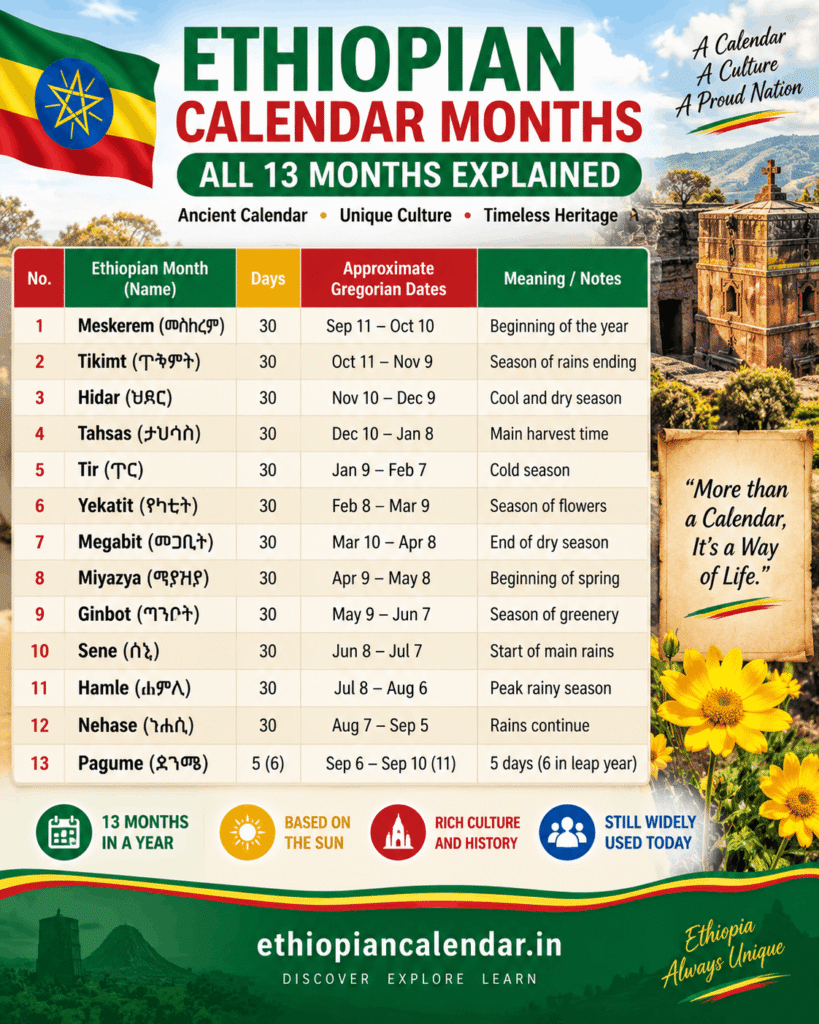
The 13 Ethiopian Calendar Months
| Month | Days | Gregorian Period | Description |
|---|---|---|---|
| Meskerem | 30 | September–October | Ethiopian New Year begins |
| Tikimt | 30 | October–November | Second month |
| Hidar | 30 | November–December | Third month |
| Tahsas | 30 | December–January | Includes Ethiopian Christmas |
| Tir | 30 | January–February | Includes Timket |
| Yekatit | 30 | February–March | Includes Adwa Victory Day |
| Megabit | 30 | March–April | Seventh month |
| Miyazya | 30 | April–May | Easter period varies by year |
| Ginbot | 30 | May–June | Ninth month |
| Sene | 30 | June–July | Tenth month |
| Hamle | 30 | July–August | Eleventh month |
| Nehasse | 30 | August–September | Twelfth month |
| Pagume | 5 or 6 | September | 13th month |
For additional Ethiopian calendar information and date references, you can also explore the Ethiopian calendar resources available on Timeanddate.
How Many Days Are in Each Ethiopian Month?
The first 12 Ethiopian calendar months each have exactly 30 days. The 13th month, Pagume, is different because it has 5 days in a normal Ethiopian year and 6 days in a leap year. This makes the Ethiopian calendar a 13-month calendar with a total of 365 days in a normal year and 366 days in a leap year.
What Is Pagume in the Ethiopian Calendar?
Pagume is the 13th and final month of the Ethiopian calendar. It normally has 5 days, while a leap year has 6 days. Pagume comes immediately before Meskerem, the first month of the Ethiopian New Year. Because of its short length, Pagume is one of the most distinctive features of the Ethiopian calendar.
Ethiopian Calendar Months and Gregorian Dates
The Ethiopian calendar and Gregorian calendar use different year numbering and date calculations. Ethiopian months are arranged differently from Gregorian months, so the corresponding Gregorian date changes throughout the year. For an exact conversion, use our Ethiopian Date Converter to convert an Ethiopian date into its Gregorian equivalent or a Gregorian date into an Ethiopian date.
Explore our Ethiopian Calendar 2026 to see the current Ethiopian year, important dates, and major holidays. You can also download our Ethiopian Calendar 2026–2027 PDF for easy printing and offline reference.
Frequently Asked Questions About Ethiopian Calendar Months
How many months are in the Ethiopian calendar?
The Ethiopian calendar has 13 months. The first 12 months have 30 days each, and the 13th month, Pagume, has 5 days in a normal year or 6 days in a leap year.
What are the 13 months of the Ethiopian calendar?
The 13 Ethiopian calendar months are Meskerem, Tikimt, Hidar, Tahsas, Tir, Yekatit, Megabit, Miyazya, Ginbot, Sene, Hamle, Nehasse, and Pagume.
How many days are in an Ethiopian calendar month?
The first 12 Ethiopian calendar months each have 30 days. Pagume, the 13th month, has 5 days in a normal year and 6 days in a leap year.
What is the 13th month of the Ethiopian calendar?
Pagume is the 13th and final month of the Ethiopian calendar. It has 5 days in a normal year and 6 days in a leap year. It comes immediately before Meskerem, the first month of the Ethiopian New Year.
Is the Ethiopian calendar the same as the Gregorian calendar?
No. The Ethiopian calendar and Gregorian calendar are different calendar systems with different year numbering and date calculations. The Ethiopian calendar has 13 months, while the Gregorian calendar has 12 months. You can use our Ethiopian Date Converter to find the corresponding date in either calendar.
Which Ethiopian month has 6 days?
Pagume is the only Ethiopian calendar month that can have 6 days. It has 5 days in a normal year and 6 days in a leap year. The extra day helps keep the Ethiopian calendar aligned with the solar year.